News
SuperCDMS Collaboration News
2026-09-10: A New Result from the LZ Experiment
Congratulations to the LZ team for achieving unparalleled background reduction in Liquid Xenon Dark Matter detection, leading to the detection of an unexpected event in an essentially background-free region of parameter space. This result reminds us that dark matter may be far more mysterious than our simplest theories assume, and that complementary searches with other detectors are indispensable for uncovering its true nature. SuperCDMS is looking forward to contributing to this search, with data collection just getting underway at the SNOLAB laboratory.
2026-08-07: SuperCDMS SNOLAB Starts its Science
The SuperCDMS experiment at SNOLAB has begun its first science data-taking run, following a six month commissioning period for the newly installed experiment. This initial science run is planned to last just a couple of months, taking the experiment through the annual summer planned maintenance period for the Vale mine that hosts SNOLAB.
The data collected over these months is the first science data from the experiment and may produce world-leading results in selected detectors. We will additionally perform diagnostics of the experiment’s full detector payload and its surrounding cryogenic cooling system during this initial science run.
The SuperCDMS Collaboration and Operations team plans to follow up the first data-taking run with a warm-up of the experiment to replace a faulty cryogenic element and to further optimize the cryogenic system and the noise environment. This warm-up and repair period is expected to extend into late 2026, and will be followed by a year of science data collection with optimized detector operation.
The SuperCDMS Operations Manager, Dr. Tina Cartaro of the SLAC National Accelerator Laboratory, states “The search for dark matter is finally underway. Even in this early phase, our most sensitive detectors have the potential to deliver breakthrough discoveries. At the same time, we're preparing and testing the entire system, learning how our detectors and cryogenic cooling perform together so we can reach their design sensitivity.” SuperCDMS Collaboration Spokesperson, Professor Prisca Cushman of the University of Minnesota, states “Our detectors will explore, with unprecedented sensitivity, regions where the lightest mass dark matter particles may be lurking. This opens up new avenues in the search for dark matter”.
For more details, see the news release from the SLAC National Accelerator Laboratory.
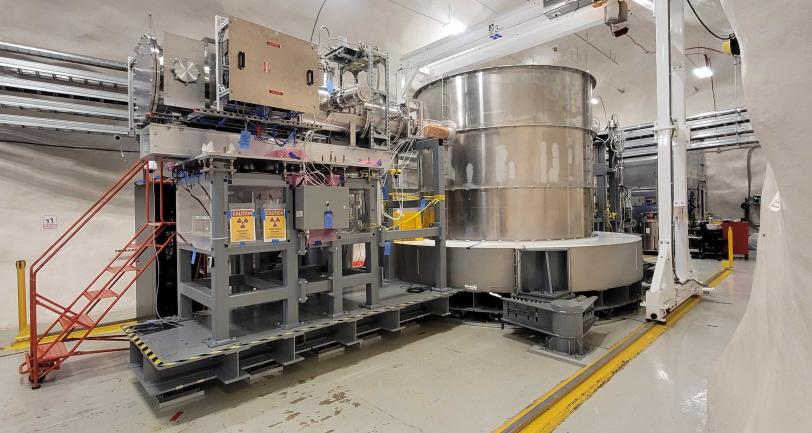
The photo shows the SuperCDMS experiment ready to take data with the cylindrical aluminum radon barrier installed around the shielded cryogenic SNOBOX containing the detectors, but prior to the installation of the outer water tanks. The cryocoolers, vacuum interface and warm electronics, and deployable calibration system are visible in the foreground, with the dilution refrigerator for the cryogenics on the far side of the shielded SNOBOX.
2026-03-17: Cooldown of SuperCDMS SNOLAB
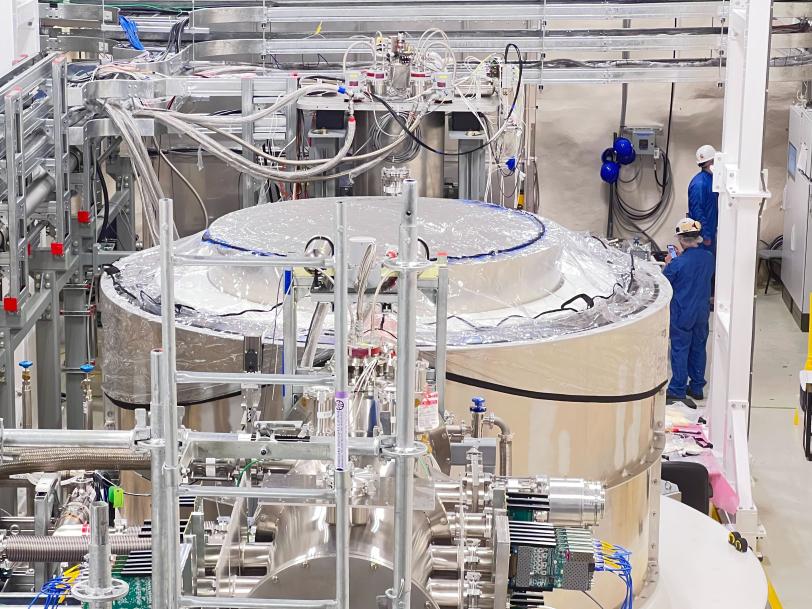
SuperCDMS SNOLAB has been cooled down to near absolute zero, in preparation for one of the world’s most sensitive dark matter searches.
The SuperCDMS detectors have been cooled to their operating temperature of about 30 mK. The SuperCDMS collaboration is now commissioning the experiment and detectors, ahead of beginning its first science run later in 2026.
For more details, see the news release from the SLAC National Accelerator Laboratory.
2024-06-11: Meeting of SuperCDMS Collaboration at SNOLAB
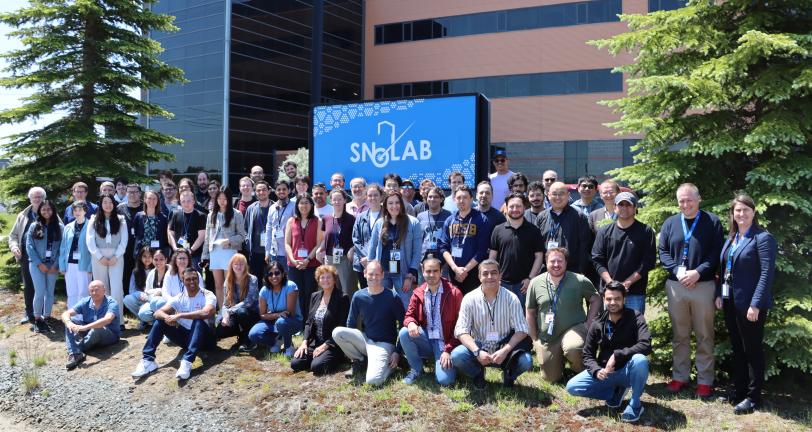
Members of the SuperCDMS Collaboration met at SNOLAB in Sudbury Ontario this week, to exchange information and discuss and plan future work of the collaboration in setting up the experiment at SNOLAB.